
A buried treasure of history awaits you at the U.S. Postal Service Museum in Marshall.
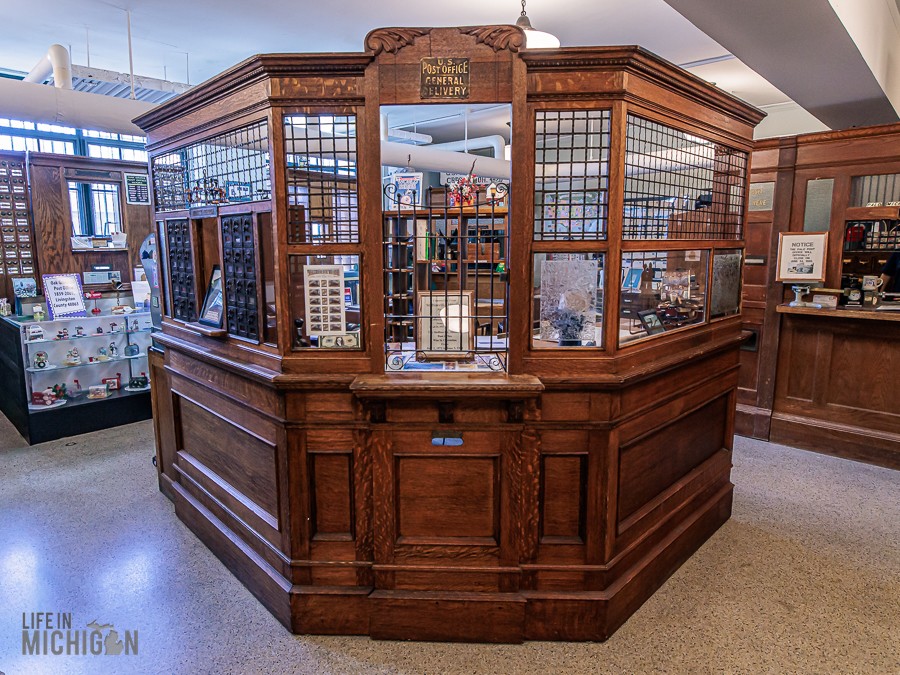
Marshall, Michigan’s United States Postal Service Museum
A collection of Americana that pays homage to a nearly forgotten chapter of our nation’s history, the post office, is in Marshall, Michigan’s United States Postal Service Museum. Even more remarkable, it is second only to the Smithsonian’s National Postal Museum in Washington, D.C., in size.
It is only fitting that this chapter of Michigan’s history is housed in the basement of the historic 1934 Greek Revival Post Office in Marshall, Michigan. The museum comes to life through Mike Schragg, a retired Marshall Postmaster whose personal story is as compelling as the artifacts he curates.
Meet Mike Schragg
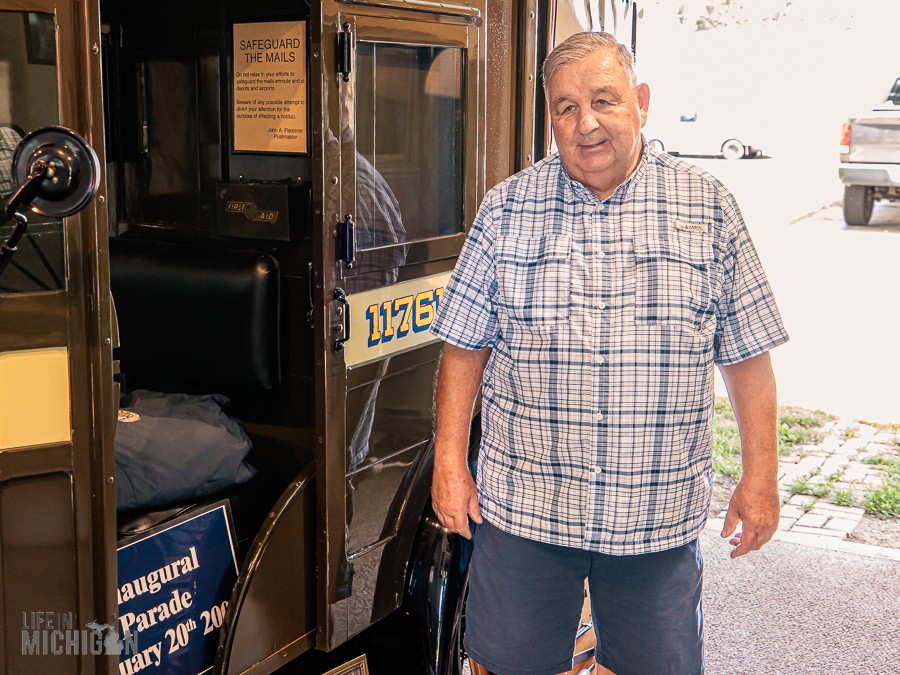
Mike Schragg, Museum Curator
Mike got his start sorting mail in the Army. After attending college for a year and a half in 1965, Mike was drafted into the U.S. Army and joined the Army Post Office. He attended postal school in a class of 30, where 25 of his classmates were sent to Vietnam, and 5 were assigned to Germany. He went to Germany.
Right after getting out of the military in June 1970, he knocked on the door of the Marshall Post Office and was hired two weeks later, starting out as a substitute clerk carrier. In 1979, he got the Postmaster position in Marshall, a post he held until his retirement in 2002. At the time of his retirement, he managed 32 employees, 6 rural routes, and 6 city routes.
In 1987, when the Marshall Home Tour needed an extra building, Mike got permission from headquarters in Grand Rapids to open the post office upstairs and dress in period costume. Visitors mistakenly assumed the active post office was a museum. “I said, no, we really work here,” Mike recalled with a laugh.
That moment ignited his mission. Mike took over the building’s former military recruiter’s office room in the basement and, over the years, has expanded the museum into seven basement rooms. He has spent decades collecting and buying, often with his own money, the artifacts that fill the museum.
Behind every envelope and stamp lies a story, and Mike is eager to share it.
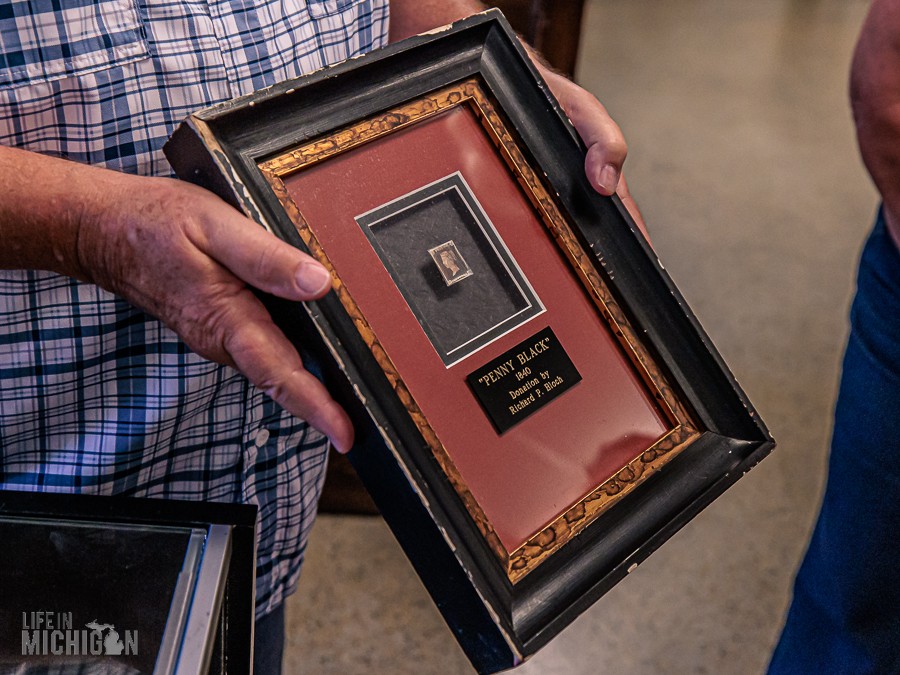
The Black Penny Stamp
It’s an unforgettable, quirky journey through Michigan history powered by one man’s lifelong love for the mail!
Storefront Post Offices & The RFD Revolution
In early Michigan history, many post offices were far from standard federal buildings. They operated right out of local grocery stores or hardware shops where postmasters had to buy their own equipment and counter setups. The museum has a preserved counter from Mets, Michigan, where residents without a paid PO Box had to shout their box number through a window to get their mail!
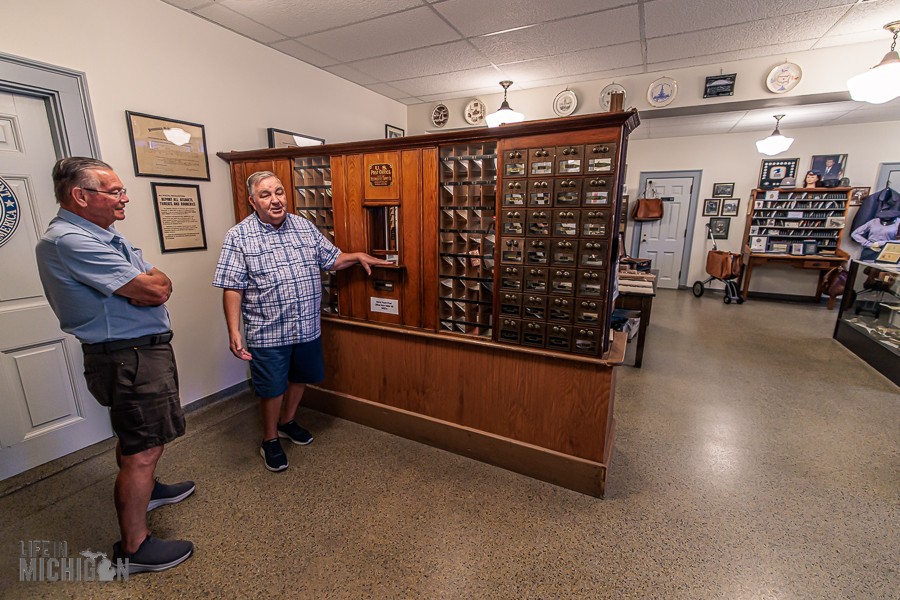
Greg Davitt & Mike Schragg in front of the Met’s Post Office
Before Rural Free Delivery (RFD), farmers had to trek into town just to check their mail. That all changed when the National Grange Association lobbied Congress for farm deliveries. Climax, Michigan landed the state’s very first rural route on December 3rd, 1896—and Mike let us in on a little local secret as to why: “Why did Climax get it and not Marshall or Battle Creek or Lansing? The Congressman that helped sponsor it lived in Climax! He made sure his town got the 1st rural route.”
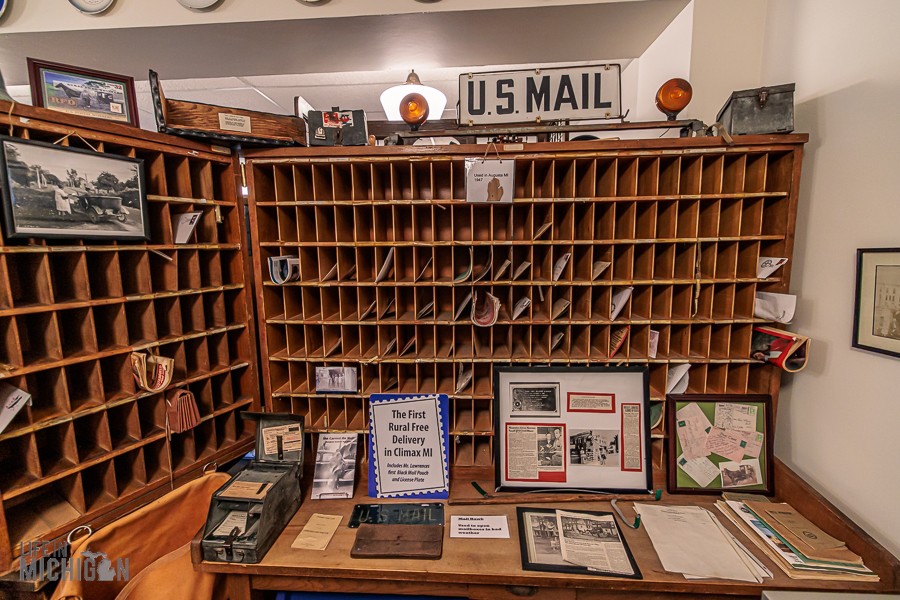
Rural Free Delivery Display
While RFD was a dream for farmers, it rocked the world of local storekeepers. As Mike explained, “When RFD started nationwide, within 5 years, a third of our post offices disappeared… The rural carrier sold them stamps, delivered their mail, picked up their mail, did it all as a traveling post office.” Overnight, tiny post offices in places like Ellis Corners, Marengo, and Eckford vanished because the mailman was now coming directly to the farm.
The Ceresco Post Office
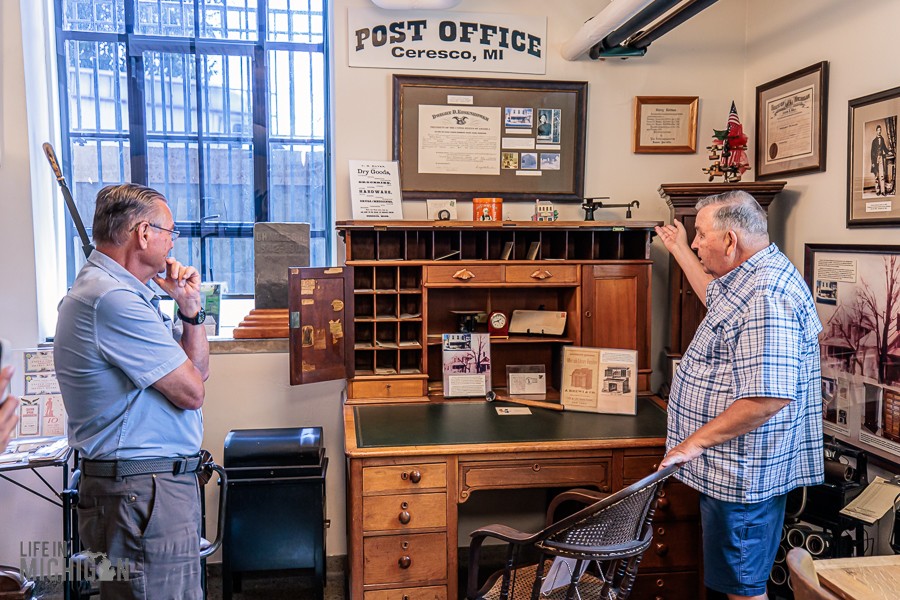
Greg Davitt & Michael Schragg looking at Charles Raven’s all-in-one sorting desk built
One of Mike’s absolute favorite pieces in the museum is an all-in-one sorting desk built by Civil War veteran Charles Raven. After recovering from his war wounds, Raven settled in nearby Ceresco, Michigan, and became the town postmaster. He ran the town’s post office right out of his home starting in the late 1800s.
Because postmasters had to supply their own equipment, Raven built a custom sorting desk that doubled as his official post office. “He couldn’t afford a metal safe, so he made his own safe out of wood!” Mike pointed out. “These are all wooden cigar boxes! He kept his stamps in cigar boxes. He knew how to recycle.”
Raven’s setup didn’t stop at mail; his early advertisements show he ran what Mike calls “the first Walmart or Meijer of Michigan!” Raven sold dry goods, groceries, hardware, medicine, paint, coal, wine, and even insurance alongside his postmaster duties.
Mike shared a personal connection to the piece: when he was a kid in the 1950s and ’60s, Mrs. Lee ran the Ceresco Post Office out of that very same building. “She might be sitting in the living room watching soap operas on TV, and she would invite me in… and give me a piece of gummy candy.”
Today, Raven’s original desk, complete with his wooden cigar-box safe and a restored 1907 headstone saved by his great-great-grandson, stands as one of the museum’s most incredible local treasures.
The Political Shift
Until President Nixon put the Postal Service on a merit system in 1971, postmaster appointments were purely political. As Mike put it: “You had to be a good Democrat or a good Republican to be a postmaster… Every four years, you had a chance, because if the Democrats were in charge and Republicans won two years ago, you would have been fired.”
To drive the point home, he showed us the original 1885 suspension letter signed by President Grover Cleveland, firing a Marshall postmaster over party lines.
Historic Letter and Messages That Made It… Eventually!
A stunning 1844 stampless letter was mailed right out of Marshall for just 2 cents. The writer, a traveling fur buyer, described stopping in town when it had grown to “1,600 people, 3 churches, a courthouse, 4 taverns, 8 to 10 stores” and stayed under the roof of Presbyterian minister John D. Pierce, the very man who helped write the Michigan school system!
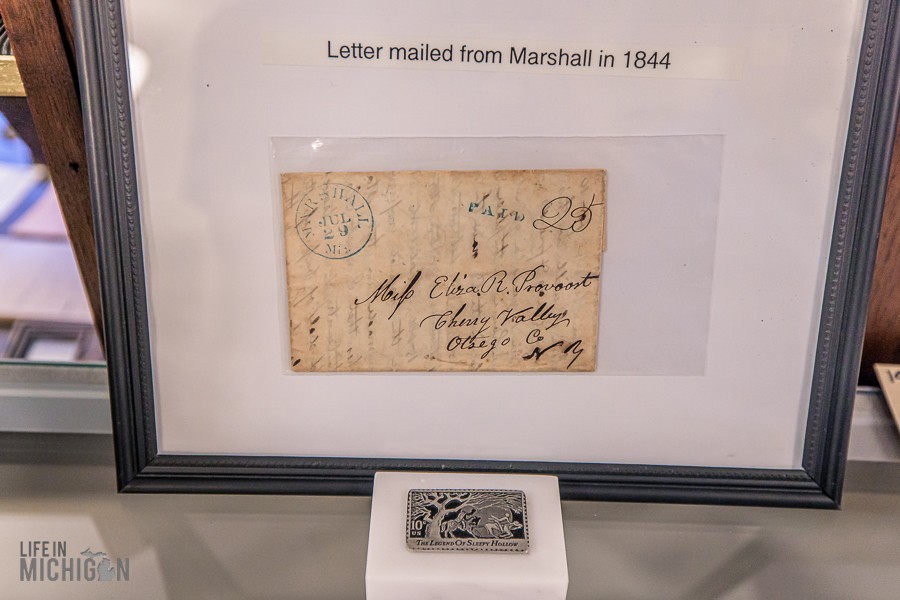
1844 Letter
Then there were the letters that took the really long way home.
Mike shared the story of 21 World War II letters discovered in 1995, stuck for 50 years inside the mail chute walls of the former Percy Jones Hospital in Battle Creek (where Senator Bob Dole once recovered from his war wounds).
The Postal Service managed to deliver 18 of them, including three written by a wounded lieutenant to his pregnant wife. But not every delivery had a fairy-tale ending. As Mike chuckled, one letter revealed a deceased husband’s secret wartime girlfriend to his surviving widow: “Her daughter called my boss in Grand Rapids and said, ‘Why would you do this to my mom?’ My boss said, ‘We didn’t know…’ The daughter’s last comment to my boss was, ‘Good thing my dad was dead, because Mom would have shot him after reading that!'”
A “Museum Within a Museum” & The Great Depression Quilt
Down the hallway, we stepped into a true “museum within a museum.” When the Michigan Rural Letter Carriers’ Association needed a new home for their historic collection, Mike jumped at the opportunity to host them. “When they didn’t want them there anymore, and I heard about it. I said, ‘I got a room for you if you want to move in here!’
This space holds amazing pieces of rural postal history, including:
The 1903 Rural Mail Buggy: A fully canvassed, weather-proofed buggy built before Parcel Post began in 1913. It even features a narrow glass window that gave carriers a sliver of visibility during freezing Michigan winters.
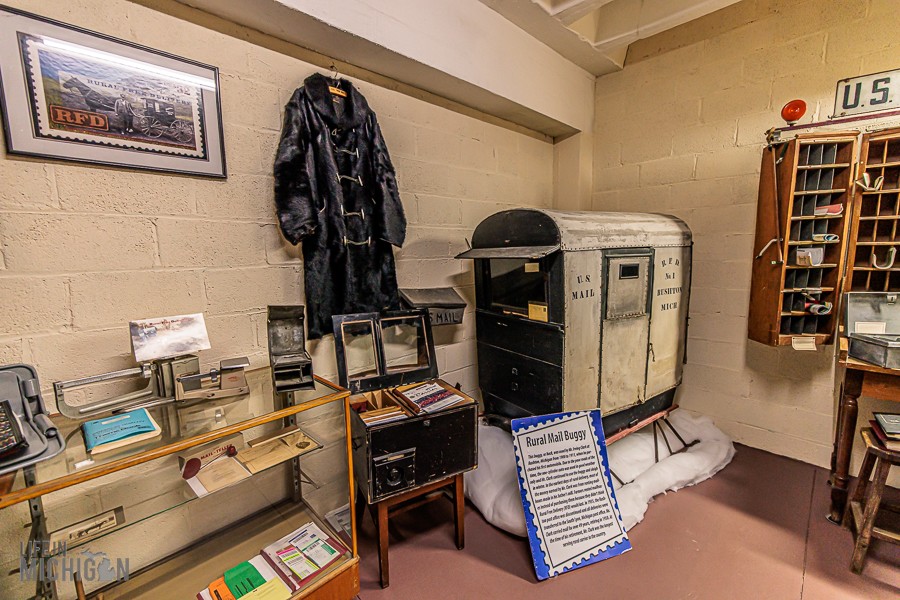
Rural Free Carriers Display
Bearskin Coats: Heavy, full-length bearskin coats worn by early carriers like Mr. Clark out of Rushton, Michigan, who had to survive brutal open-air winter routes.
The Great Depression Carrier Quilt: One of the most touching items in the entire museum is a hand-stitched quilt created during the Great Depression. Because rural mail carriers kept their steady government jobs while so many others suffered, they felt a deep responsibility to help. County by county, from Jackson to Ingham, carriers donated a dollar to have their names embroidered onto quilt squares. The association then auctioned off the finished quilt at their state convention and donated every cent to soup kitchens across Michigan.
Inside the Coal Bin: Scooters, Split Jeeps & The “Cadillac” Buggy
Next, Mike led us into the building’s original coal bin—a massive space that once held two full train cars of coal to heat the post office. Painted numbers on the walls still mark the coal’s former height, bleeding through the layers of paint.
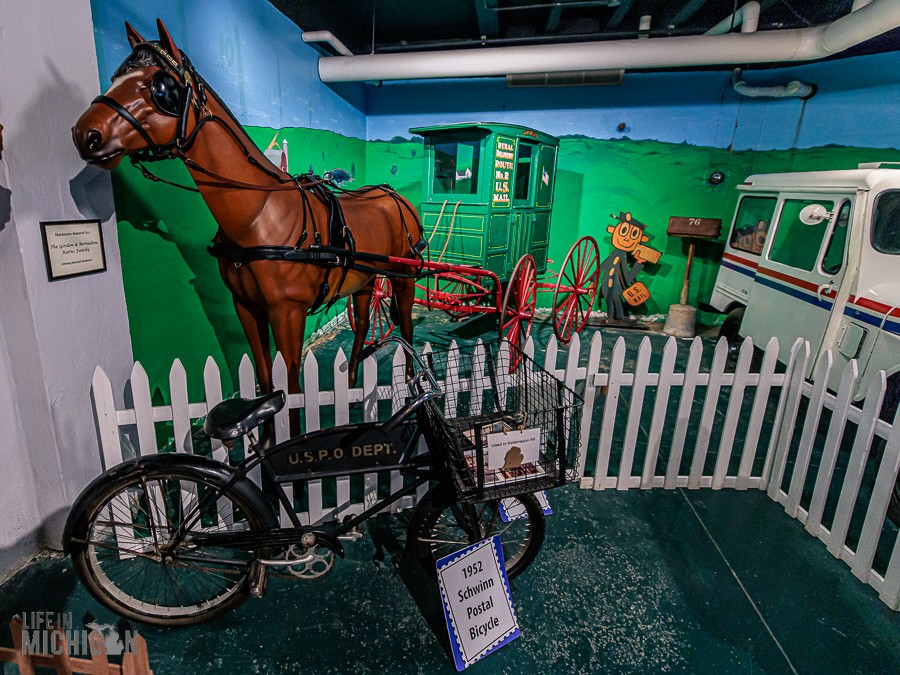
Behind the horse, you can see the numbers bleeding through
Today, the coal bin houses a fascinating fleet of postal vehicles.
To get a 1977 postal Jeep down into the basement display room, high school students at the Battle Creek Vocational Center literally cut the vehicle completely in half, stripped the engine and gas tank for safety, and reassembled it downstairs!
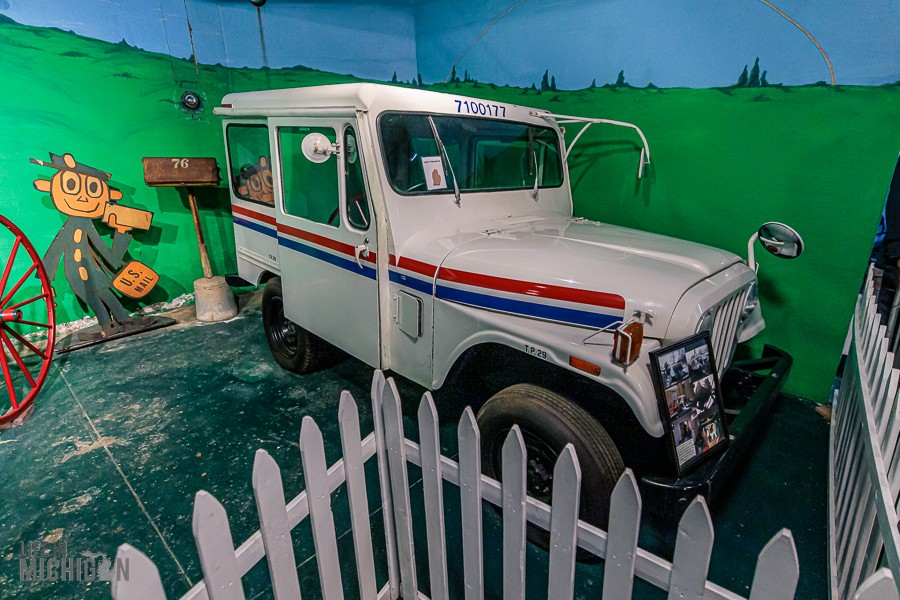
1977 postal Jeep
A 3-wheeled fiberglass motor scooter used out West (in Michigan, carriers typically used canvas Cushman scooters).
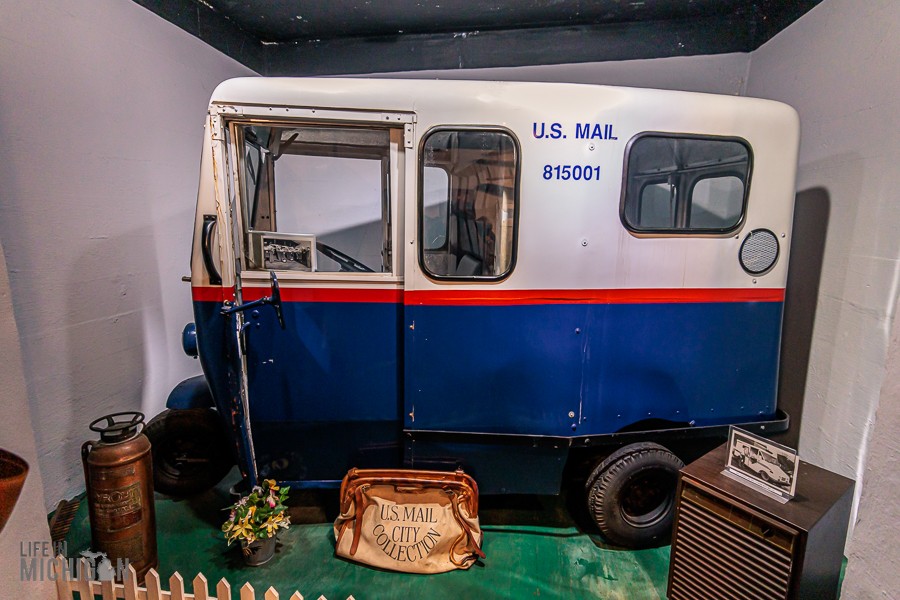
A 3-wheeled fiberglass motor scooter
Of the five mail buggies in the museum, Mike calls the 1904 model by the Harrington Manufacturing Company his absolute favorite: “Out of the five mail buggies, this is my Cadillac one!” Bought through private donations and help from his parents, this beautifully restored buggy even featured luxury spring suspension for rough country roads, and Mike has driven it in several local parades.
The Grand Finale
Parked outside is Mike’s absolute pride and joy, a pristine 1931 Model A Ford mail truck with an all-oak body built by the Mifflinburg Buggy Company. Used in Grand Rapids until 1947, this beauty was even selected to drive down Pennsylvania Avenue in President George W. Bush’s 2001 Inaugural Parade! “Ford Motor Company, Detroit came and picked this up for me, free of charge, took it down there, then I met him down there and got it, and drove it in the parade and back,” Mike remembered proudly.
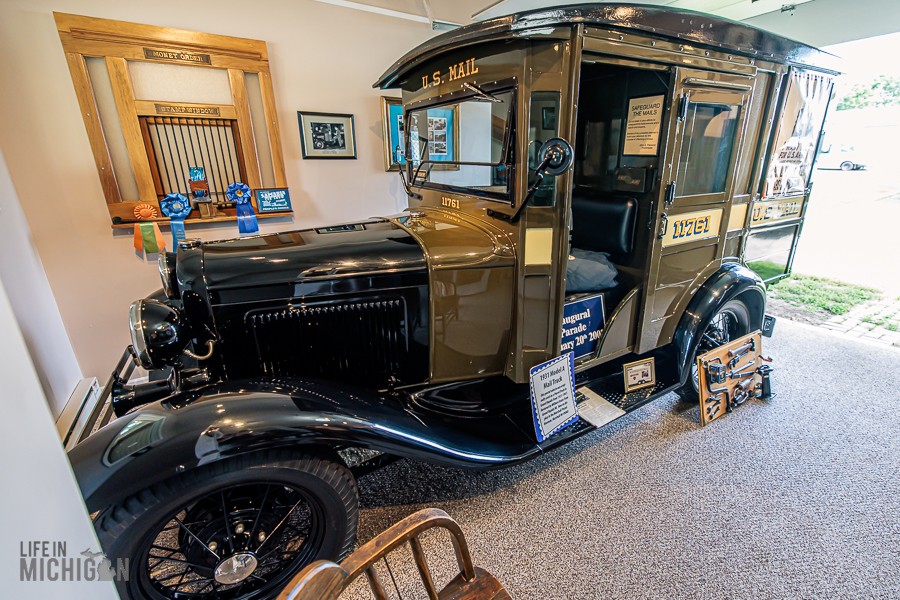
1931 Model A Ford mail truck
Look beneath the surface in Marshall to discover this phenomenal piece of Michigan postal history. To visit the U.S. Post Office Museum, located in the basement of the main post office, is by appointment only. Call 269-781-2859.
Photos
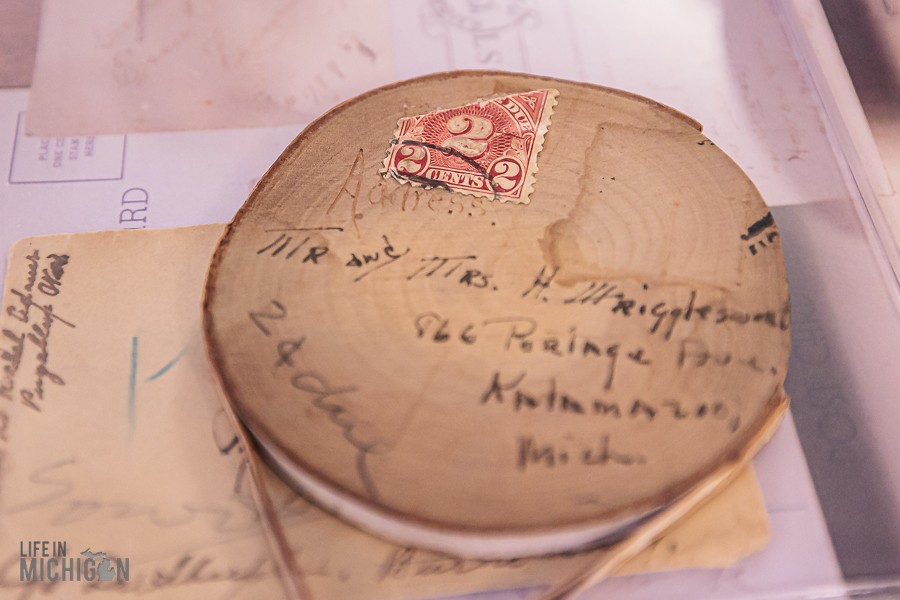
A postcard on a wooden disk
Many more pictures in our gallery.
Become a Supporter!
We believe Michigan is more than just a place—it’s a way of life. This belief is the foundation of our mission, which is to document the stories, community life, and cultural experiences that mainstream media often overlook.
Through digital publishing, photography, and podcasting, we share Michigan’s stories, culture, and spirit with a global audience, maintaining a permanent archive that ensures anyone, regardless of where they live, can find and experience the traditions that define our state.
Your support enables us to continue sharing the unique and captivating stories that showcase Michigan in all its vibrant glory. Whether you donate to our mission, treat yourself to a warm hoodie, or provide ongoing support through Substack, every contribution helps enhance our mission.
If our content resonates with you, we encourage you to become an ambassador for our stories. Share our work on your social media or forward a link to someone who would appreciate it as much as you do.
Stay Connected
We’d love it if you liked our Facebook page. Better yet, subscribe to our Sunday Sip newsletter on Substack. You can also find us on Instagram and YouTube.