
You can hardly walk through Detroit without spotting a Pewabic Pottery installation. The tiles are everywhere. They are tucked into the Detroit Public Library, shining at Comerica Park. brightening the QLine and People Mover stations, even greeting visitors at the Detroit Zoo. And that is just the beginning. There are so many that Pewabic created a map so you can take yourself on a self-guided tour and impress your friends with your tile spotting talent.

Pewabic Pottery Tour
So when Chuck suggested we take a docent-led tour at Pewabic Pottery, I said, “Yes, please,” hoping to learn more about the place that creates the iconic iridescent tiles. I always assumed Pewabic was a private studio, the kind of place where getting past the gift shop required secret powers or some VIP clearance.
I could not have been more wrong. Pewabic is a nonprofit with a mission to enrich the human spirit through clay. Today, it is a working pottery, an education center, and yes, they offer docent-led tours on select days. The only secret power required is a little planning.
We bought our tickets and arrived early enough to wander the gift shop on the first floor. Since it was close to Thanksgiving, the displays were dressed with sprigs of holly and evergreen, giving the whole place a warm, festive glow.

Tiles, bowls, pottery, glassware, jewelry. I filled my basket with potential gifts. Potential, because I was already debating whether I could actually give them away.

A display of books caught my eye, especially Cara Catallo’s Pewabic Pottery: A History Handcrafted in Detroit. Generally, the acknowledgments page of a book is not exactly gripping material, but I was pulled right in. The index and bibliography alone were worth the price. Naturally, it found its way into my basket.
Pewabic Pottery’s History
Our docent, Toni, appeared a few minutes before the tour started.

She gathered the group and ushered us to the second-floor museum, where even the handrail was dressed with garland. A nice touch.

Everything I knew about Pewabic could have fit in my front pocket. I was ready to learn how this place became a Detroit institution.
Toni walked us through the displays, adding context and stories that made Pewabic’s early years feel alive. She introduced us to Mary Chase Perry Stratton, one of the founders, and shared small details about Mary’s life. She was born in Hancock, Michigan. Her father was a physician. Straightforward facts, but both would become important to the Pewabic story.

Toni mentioned Mary’s father died in 1877, but did not offer many details. Later, while reading Cara Catallo’s book, I was stunned to learn that Dr. Perry had been beaten with an axe handle by an angry traveler who mistook him for someone else. He did not recover. This bit of history drove home how violent the late 1800s could be and what Mary’s mother, Sophie Perry, must have faced as she prepared to support her three children.
Mary’s Arkwork Takes Flight
After Dr. Perry’s death, Sophie moved the family from Hancock to Ann Arbor so her son Fred could attend the University of Michigan for pharmacy training. That also happened to be her husband’s alma mater.
In Ann Arbor, Mary took her first painting lesson. She went on to study through correspondence courses at the Cincinnati Art Academy from 1887 to 1889, and later at the Detroit Museum of Art school. She focused on china painting and quickly found success. Soon, she was traveling nationwide, teaching others.
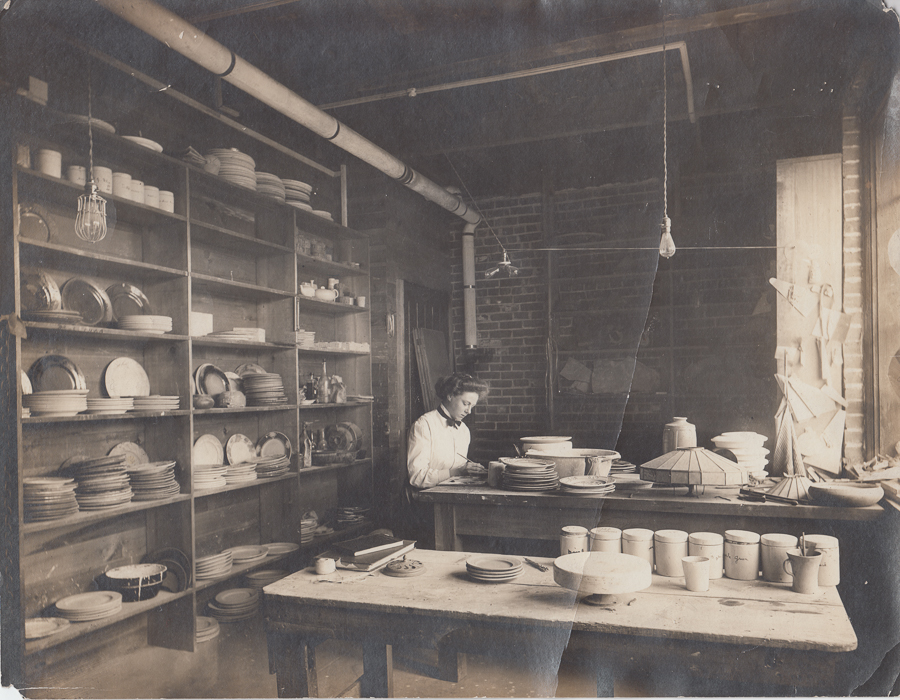
Photo courtesy of Pewabic Pottery
But even with her accomplishments, Mary felt china painting was a passing fad. Catallo writes that Mary believed becoming a potter would bring greater artistic respect and deeper fulfillment. She was not alone in that thinking.

Brush Park, Detroit
After Fred finished school, the Perry family moved to Detroit’s Brush Park neighborhood, where he opened a pharmacy on Woodward Avenue. When Mary was not teaching, she returned home to Brush Park.
In 1896, she met her neighbor, Horace J. Caulkins, a dealer in dental supplies and the creator of the Revelation kiln. Mary eventually partnered with him, serving as a saleswoman for the kiln. Their business relationship would last a lifetime.

The Stable Studio
In 1900, Mary and Horace rented studio space in a former stable in Brush Park. Mary began experimenting with clay and the iridescent glazes that would become Pewabic’s signature look. She once said, “My glazes are based on well known formulas which are well within the reach of anyone. These are modified from experiment till I have made them my own.”

I was amazed to learn she experimented with uranium early on to create an orange glaze. I didn’t see that fact coming.

Pewabic Pottery is Established
In 1903, Mary and Horace received their first large commission. It also meant they needed to get serious about a brand. Mary pulled together a list of possible names. On the list was Pewabic. It was inspired by her life in Hancock, Michigan. She and her father would take walks near the Pewabic Mine, not far from their home. Mary wrote in her journals that she liked the way the word sounded.
Frank Burley from the ceramics sales house, who commissioned their first order, “pounced upon Pewabic, declaring that being an Indian word, it was purely American and we couldn’t have too much of that,” Mary would later share.
A New Home on Jefferson Avenue
In 1906, architects Frank Baldwin and William Buck Stratton were hired to design a new studio on Jefferson Avenue. The building was expanded in 1912, and in 2018, a new addition was built. At one point during the tour, Toni pointed to the museum floor. We all looked down to see the original Pewabic tile that was installed when the building first opened—a small but magical detail.

Where the Magic Happens
When our history lesson was over, Toni directed us back down the stairs, through the gift shop, to the workshops. Have you ever been invited backstage for a play or live music performance? If you have, you have a sense of what I was feeling.
We stepped through a doorway marked Clay + Glaze Room. Black and yellow tape on the floor warned us not to wander into the work area.

Toni explained how the modern kilns operate while we nodded politely, pretending we understood kiln science.

We made our way further into the studio, coming to the area where the clay is made and the glaze is applied. I couldn’t help but admire the staff’s sense of humor.

The 2018 addition holds the molds and is where the craftspeople create the beautiful Pewabic tiles we see all around Detroit and, for that matter, the country.

Pewabic’s Legacy
Mary eventually married architect Buck Stratton in 1918. He died before she did, and since they had no children, her shares of Pewabic went to Horace Caulkins’ son, Henry. He later approached Michigan State University about taking over the pottery. MSU used it for its ceramics program for a time.
In 1981, Pewabic was officially transferred to the Pewabic Society, a nonprofit organization that continues the work Mary and Horace began.
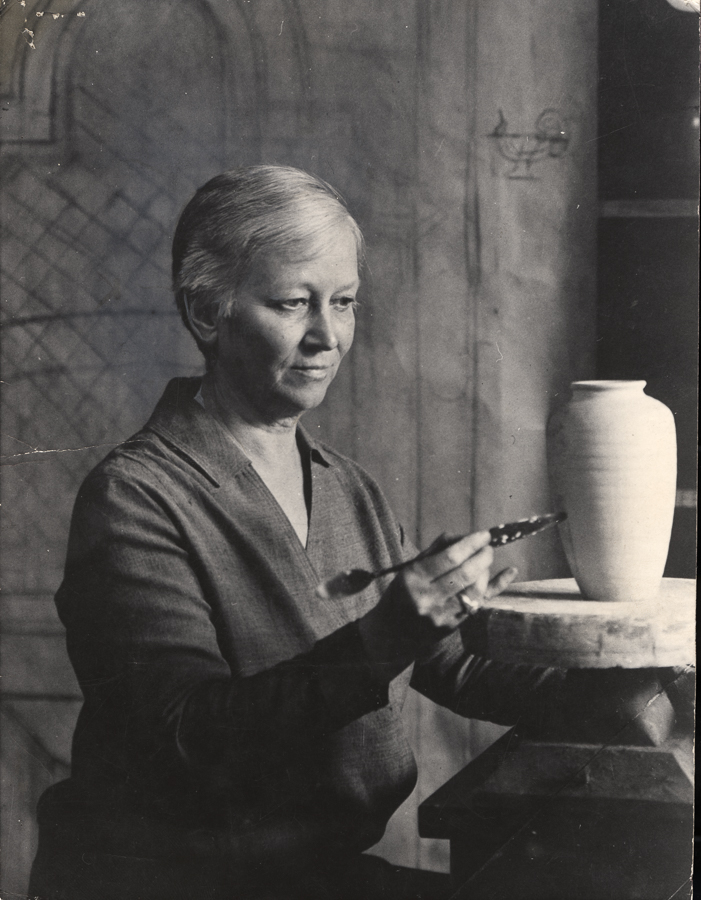
Photo courtesy of Pewabic Pottery
Another lasting legacy is the many Pewabic tile installations found in churches across the country. Detroiters are fortunate to have one in the Cathedral Church of Saint Paul. Toni mentioned it was open until 2 in the afternoon, so of course, we headed straight to 4800 Woodward to see it.


If you are looking for a deeper connection to Detroit’s art and history, a visit to Pewabic Pottery is a perfect place to start. The tour blends storytelling, craftsmanship, and a behind-the-scenes look at how those iconic tiles are still made today. It is an experience that stays with you long after you leave.
More Photos
We’ve got a few more photos from our visit to Pewabic Pottery in our gallery.

Become a Supporter!
We warmly invite you to join our Life In Michigan community. Your support is not just appreciated—it is essential. It enables us to continue sharing the unique and captivating stories that showcase Michigan in all its vibrant glory. Whether you buy us a beer, treat yourself to a snuggly warm hoodie, or provide ongoing support through Substack, every contribution helps enhance our mission.
If our content resonates with you, we encourage you to become ambassadors of our stories. Share our work on your social media or forward a link to someone who would appreciate it as much as you do. Your support, in any form, breathes life into our cause and keeps the spirit of Life in Michigan thriving.
Thank you for being a vital part of our community.
Stay Connected
We’d love it if you liked our Facebook page. Better yet, subscribe to our Sunday Sip newsletter through Substack. You can also find us on Instagram.